
CGPA Calculator
Enter your semester SGPA and credits to calculate your Cumulative Grade Point Average across all semesters.
Enter your semester SGPA values above to see your CGPA here.
Semester-wise breakdown will appear here.
CGPA Calculator
Calculate Cumulative GPA with Credits & Convert to Percentage Instantly
If you are a college student pursuing Engineering, BBA, BSc, or any other degree program, you know that your academic performance is no longer measured in plain percentages. The modern education system relies heavily on the Cumulative Grade Point Average (CGPA).
Whether you are applying for a master’s degree (MS/MTech/MBA), sitting for campus placements, or applying for government jobs, your CGPA is the single most important number on your resume. However, calculating your CGPA manually can be incredibly confusing, especially when different semesters have different credit loads.
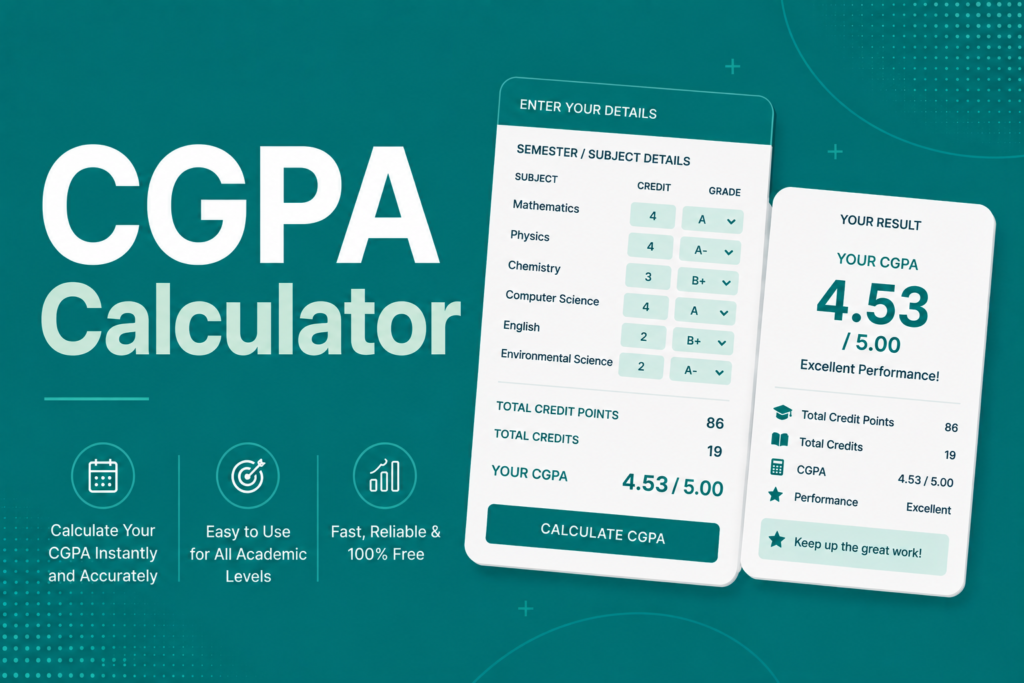
To solve this, we built the most advanced CGPA Calculator online. It allows you to input your semester SGPA and credits, automatically handles the complex math, and instantly converts your CGPA to a percentage.
What is CGPA? (Cumulative Grade Point Average)
CGPA stands for Cumulative Grade Point Average. It is a standardized way of measuring your overall academic performance across all semesters of your degree program. While an SGPA (Semester Grade Point Average) only reflects your performance in a single semester, your CGPA reflects your average performance from your very first semester up to your current semester.
Most Indian universities use a 10-point grading scale. For example, if you consistently score an “O” (Outstanding) or “A+” grade, your CGPA will hover between 9.0 and 10.0. If your grades are a mix of B’s and C’s, your CGPA might sit around 6.0 to 7.0.
Understanding your CGPA is crucial because:
- Higher Education: Foreign universities and top Indian institutes (like IITs/IIMs) require a minimum CGPA (usually 8.0 or 8.5) for admission.
- Campus Placements: Top IT companies and consultancies (like TCS, Infosys, Deloitte) have strict CGPA cutoffs (often 6.0 or 6.5) just to sit for their aptitude tests.
- Government Exams: Some PSUs and government bodies ask for a converted percentage rather than a CGPA, making accurate conversion essential.
The Problem with Manual CGPA Calculation
You cannot calculate your CGPA by simply adding up your SGPAs and dividing by the number of semesters—unless every single semester has the exact same number of credits.
In reality, universities assign different credit hours to different subjects. A heavy lab subject might carry 4 credits, while a seminar might carry only 1 credit. Because of this, a 9.0 SGPA in a semester with 28 credits holds more weight than a 9.0 SGPA in a semester with 20 credits.
Doing this weighted math manually for 6 to 8 semesters often leads to calculation errors. Our online CGPA calculator eliminates this risk by doing the heavy lifting for you.
Two Methods to Calculate CGPA (Which One Should You Use?)
Our tool offers two distinct calculation methods based on the data you have available. Here is how both work:
1. Weighted Average Calculation (With Credits)
This is the most accurate and scientifically correct method. In this method, each semester contributes proportionally to its credit load. If Semester 1 has 24 credits and Semester 2 has 26 credits, Semester 2 will have a slightly higher impact on your final CGPA.
The Formula: CGPA = (Sum of [SGPA × Semester Credits] for all semesters) ÷ (Total Credits of all semesters)
Example:
- Semester 1: SGPA 7.0, Credits 22 → (7.0 × 22) = 154
- Semester 2: SGPA 8.0, Credits 26 → (8.0 × 26) = 208
- Total Weighted Points = 154 + 208 = 362
- Total Credits = 22 + 26 = 48
- CGPA = 362 ÷ 48 = 7.54
2. Simple Average Calculation (Without Credits)
Use this method only if you do not know the credit count for your semesters. In this method, all semesters are treated equally regardless of how many subjects or labs you took that semester.
The Formula: CGPA = (Sum of SGPAs for all semesters) ÷ (Total Number of Semesters)
Example:
- Semester 1: 7.0
- Semester 2: 8.0
- CGPA = (7.0 + 8.0) ÷ 2 = 7.50
(Note: If your university provides a credit system, always use the “With Credits” method on our tool for an accurate result).
How to Use Our CGPA Calculator
Using the tool is incredibly simple and takes less than a minute. Here is the step-by-step process:
Step 1: Select Your University Choose your university from the dropdown menu. We have pre-loaded settings for major universities to ensure the interface matches your grading system.
Step 2: Choose Your Calculation Mode Toggle between “With Credits” (Weighted Average) and “Without Credits” (Simple Average). If you select “With Credits”, the tool will open an extra column to enter your credit hours.
Step 3: Enter Semester Data In the table, input your SGPA for each completed semester. If you are using the credit mode, enter the total credits for that specific semester. You can add or remove semester rows as needed.
Step 4: Instant Results As soon as you type the numbers, the tool calculates:
- Your exact CGPA (e.g., 7.62)
- Your Total Credits (e.g., 144)
- Your estimated Percentage (e.g., 68.68%)
University-Wise CGPA Calculation Rules
Different Indian universities have slightly different credit systems and grading scales. Our university CGPA calculator is designed to handle all of them. Here is how CGPA calculation works across major Indian universities:
1. JNTUH (Jawaharlal Nehru Technological University, Hyderabad)
JNTUH follows a strict 10-point grading system. A typical Engineering semester at JNTUH has around 22 to 26 credits. Labs usually carry 2 credits, while core theory subjects carry 3 to 4 credits. JNTUH students must use the weighted average method because credit loads fluctuate significantly between the 1st year and the final year.
2. SRM University
SRM Institute of Science and Technology uses a 10-point absolute grading system. The credits per semester usually range from 24 to 30. SRM requires students to calculate their CGPA using the exact weighted formula, which our tool handles perfectly.
3. Anna University
Anna University calculates CGPA strictly using the credit-based weighted average method. They use grades like O, A+, A, B+, etc., which are converted to grade points (10, 9, 8, 7). Anna University students can safely rely on our tool to match their official grade card calculation.
4. VTU (Visvesvaraya Technological University)
VTU in Karnataka follows a similar credit-based system where the SGPA is calculated first, and then the CGPA is derived using the total credits across all semesters.
(Note: Even if your university is not listed here, the mathematical logic of CGPA remains the same across all universities. Just select “Custom” or a generic option, and the tool will calculate it accurately).
CGPA to Percentage Conversion
One of the most stressful parts of filling out application forms is converting your CGPA into a percentage. Different forms ask for different formats—some want CGPA out of 10, some want a percentage, and some want a percentage out of 4 (GPA).
Our tool has a built-in CGPA to Percentage converter that does this instantly. Here is how the conversion generally works:
The Standard Formula (Used by CBSE, Most Universities)
Percentage = CGPA × 9.5
Example: If your CGPA is 7.62, your percentage is 7.62 × 9.5 = 72.39%
University-Specific Formulas
Be careful! Some top universities do not use the 9.5 multiplier. Our tool allows you to calculate based on standard rules, but if your university uses a specific formula, here is what you need to know:
- Anna University: Percentage = (CGPA – 0.75) × 10
- Mumbai University (7-point scale): Percentage = 7.1 × CGPA + 11 (Approximate formula used for job applications)
- VTU: Percentage = (CGPA – 0.75) × 10
- JNTUH: Percentage = (CGPA – 0.75) × 10 (Many students use this for PSUs, though officially JNTUH provides a percentage on the transcript).
Always check your university’s official academic handbook to confirm their specific conversion formula before submitting it to an employer or foreign university.
Percentage to CGPA Conversion
Sometimes, you face the opposite problem. You have an old degree that only provides a percentage (e.g., you scored 78%), but the new job portal or MS application demands a CGPA out of 10.
Our tool includes a Percentage to CGPA converter for exactly this scenario.
The Standard Formula: CGPA = Percentage ÷ 9.5
Example: If your percentage is 78%, your CGPA is 78 ÷ 9.5 = 8.21
This reverse calculation is incredibly useful for students who took their exams under an older syllabus that didn’t use the grading system, but now need to apply to platforms that strictly require a CGPA format.
Why Use Our Online CGPA Calculator Over Manual Math?
1. Handles Weighted Math Flawlessly Calculating 8 different SGPAs multiplied by 8 different credit loads on a basic calculator often leads to pressing the wrong button. Our tool’s algorithm ensures 100% mathematical accuracy every single time.
2. Dual Calculation Modes No other online tool offers the flexibility to switch between “With Credits” and “Without Credits.” If you lost your credit sheet, you can still get an estimated CGPA using the simple average mode.
3. Instant Percentage Conversion Instead of calculating your CGPA and then opening another website to convert it to a percentage, our tool displays your CGPA, total credits, and percentage simultaneously on the same screen.
4. University Specific Presets The grading dynamics of an autonomous university like SRM are different from a state university like JNTUH. Our tool accounts for these nuances.
5. Works Perfectly on Mobile You can sit in your college computer lab, check your results on the university portal, and instantly calculate your CGPA on your phone before you even stand up from the chair.
6. 100% Free and Private We do not ask for your name, college ID, or email. Your academic data stays entirely on your device.
CGPA Calculation FAQs (Frequently Asked Questions)
Is SGPA and CGPA the same thing? No. SGPA (Semester Grade Point Average) is your performance in one specific semester. CGPA (Cumulative Grade Point Average) is the average of all your SGPAs combined across all semesters up to the current point.
Can I calculate my CGPA if I failed a semester? If you have a backlog, the failed semester usually has an SGPA of 0.0 (or it is excluded until you clear it, depending on university rules). If your university includes the failed semester in the calculation, you must enter 0 as the SGPA for that semester into the calculator.
What happens if I don’t know my semester credits? If you do not have your credit sheet, simply switch the toggle on our tool to “Without Credits” (Simple Average). It will divide your total SGPA by the number of semesters. However, this will only be an estimate; for official use, you should find your exact credits from your university transcript.
Does a 9.0 CGPA mean 90%? No. Using the standard formula (CGPA × 9.5), a 9.0 CGPA equals 85.5%. A CGPA of 10.0 equals 95% (not 100%). This is because the grading system assumes that even top scorers do not achieve absolute perfection in every single assessment parameter.
How does a low CGPA in the first semester affect my final CGPA? Because CGPA is a cumulative average, a bad first semester (e.g., 6.0 SGPA) will pull your overall CGPA down slightly. However, as you complete more semesters with higher SGPAs (e.g., 8.5 or 9.0), the impact of that first bad semester diminishes because the total credit pool becomes much larger.
Can I use this calculator for MBA or PG courses? Absolutely. Whether you are doing B.Tech, BBA, B.Com, MBA, M.Tech, or MSc, the mathematical formula for CGPA remains exactly the same. Just input your semester SGPAs and credits.
Your CGPA is a reflection of your consistency over 3 to 4 years of hard work. Don’t let a manual calculation error misrepresent your efforts. Whether you are a JNTUH student trying to figure out if you meet the 8.0 cutoff for campus placements, or an SRM student converting your CGPA for a foreign university application, accuracy is non-negotiable.
Select your university, choose your calculation mode, enter your semester data, and let our CGPA Calculator give you your exact academic score in seconds. Know your number, plan your career, and apply to your dream companies with confidence.